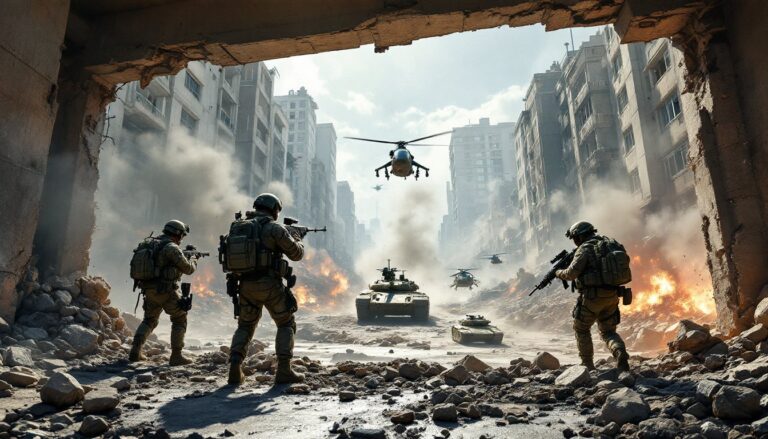

The Battlefield franchise has dominated digital first-person shooters for over two decades, but its leap to the tabletop market caught many off guard. In late 2024, publisher CMON and EA partnered to create a tactical miniatures game that captures the chaos, vehicle dominance, and squad-based warfare that made the video game series legendary. The result is a surprisingly deep war game that translates 64-player online battles into something manageable for your kitchen table, without sacrificing the franchise’s signature intensity.
This isn’t just another license cash-grab. The Battlefield board game features asymmetric faction abilities, destructible terrain mechanics, and a unique action point system that forces players into the same split-second decisions that define the digital version. Whether you’re a longtime fan of the FPS series or a tabletop veteran looking for a modern war game with actual teeth, this guide breaks down everything you need to dominate the board.
Table of Contents
ToggleKey Takeaways
- The Battlefield board game successfully translates the digital franchise’s large-scale combined arms warfare into a tactical tabletop experience with asymmetric faction abilities, destructible terrain, and a unique action point system.
- Winning the Battlefield board game requires prioritizing map control and objectives over kill counts, using a concentrated force strategy rather than spreading units equally across the board.
- Suppression and morale mechanics are more effective than outright destruction, allowing skilled players to lock down enemy positions without firing a shot—a core principle that mirrors competitive digital Battlefield gameplay.
- The base game includes four distinctly balanced factions (United States, Russia, European Union, and Pacific Coalition) plus two major expansions, providing high replayability and tactical variety for dozens of plays.
- At $130 USD for the base game, the Battlefield board game offers solid value compared to premium miniature games, with strong community support, an active competitive scene, and 300+ custom community scenarios available.
- Learning the game requires 2+ hours for initial plays but drops to 75-90 minutes once experienced, making it best suited for tactical players willing to commit to mastering complex rules rather than casual gamers.
What Is the Battlefield Board Game?
From Digital to Tabletop: The Evolution of Battlefield
The Battlefield board game launched in November 2024 as a collaboration between EA DICE and CMON, designed specifically to bring the series’ large-scale combined arms warfare to a 2-4 player tabletop format. Unlike most video game adaptations that simplify mechanics for mass appeal, this one leans into complexity. The design team included veterans from both the digital Battlefield development team and seasoned board game designers who worked on titles like Zombicide and Blood Rage.
The game exists in the modern Battlefield timeline, pulling assets and faction designs from Battlefield 2042 and Battlefield 3. Maps are inspired by iconic digital locations, Caspian Border, Siege of Shanghai, and Orbital, recreated as modular hex-grid boards with layered elevation markers. The core box supports 1v1 or 2v2 gameplay, with scenarios designed for 60-120 minute matches depending on player experience.
Key Features and Game Mechanics
Miniatures and Components: The base game includes 58 pre-assembled miniatures representing infantry squads, vehicles (tanks, helicopters, APCs), and objective markers. Miniature quality sits between entry-level and premium, detail is sharp enough to paint, but they’re durable plastic designed for repeated play. The hex-grid board uses double-layered tiles for buildings, allowing actual destruction mechanics when heavy weapons are deployed.
Action Point System: Each player gets 12 action points per turn, distributed across their units. Moving, shooting, deploying reinforcements, and calling in support (artillery, airstrikes) all cost varying amounts. This creates the same resource tension you feel in the digital game when deciding whether to push an objective or hold position.
Dynamic Objectives: Instead of static victory points, the game uses a ticket bleed system adapted from Conquest mode. Controlling more objectives drains your opponent’s reinforcement pool faster. Matches end when one side hits zero tickets or achieves a scenario-specific win condition.
Suppression and Morale: Units don’t just take damage, they accumulate suppression tokens that limit actions and force morale checks. A well-placed machine gun nest can lock down an entire flank without killing a single enemy unit, mirroring the area denial tactics that dominate competitive Battlefield play.
How to Play: Core Rules and Setup
Initial Setup and Board Configuration
Setup time runs about 10-15 minutes once you’re familiar with the system. Each scenario card specifies map layout, starting forces, and special rules. Maps are built from modular hex tiles, allowing different configurations even within the same scenario.
Players alternate placing objective markers (typically 3-5 per map), then deploy starting units within their deployment zones, usually the map edges or pre-designated sectors. The rulebook recommends balanced deployments: 60% infantry, 30% light vehicles, 10% heavy armor for standard Conquest scenarios. Specialized scenarios (Rush mode adaptations, for example) provide preset forces.
Ticket pools start at 100 for standard games, modified by scenario difficulty or player count. The first player is determined by dice roll, with the loser gaining a +2 action point bonus in round one to offset the initiative disadvantage.
Turn Structure and Action Points
Each round follows this sequence:
- Objective Control Phase: Count controlled objectives, apply ticket drain to the losing side
- Action Point Allocation: Players secretly assign action points to unit groups using dials
- Alternating Activations: Starting with the first player, activate one unit or squad, spend its allocated points, then opponent activates one of theirs
- Support Phase: Resolve any delayed artillery, airstrikes, or reinforcement drops
- Cleanup: Remove destroyed units, refresh cooldowns, advance the round marker
Action point costs break down as:
- Move (1 hex): 1 point per hex, +1 for difficult terrain
- Shoot: 2 points for small arms, 3-5 for vehicle weapons
- Suppress: 2 points, forces morale check instead of damage
- Deploy reinforcements: 4 points + unit cost
- Call support: 6-8 points depending on strike type
Units can split points between movement and combat, but can’t perform the same action twice in one activation (no double-shooting). This forces meaningful choices, do you advance and fire, or hunker down and lay suppressive fire?
Combat System and Dice Mechanics
Combat uses custom d10s with symbols instead of numbers: hits, crits, misses, and suppression results. Each weapon type has a specific dice pool. An assault rifle squad rolls 3d10 at short range, 2d10 at medium, 1d10 at long. Tank main guns roll 5d10 against vehicles but only 2d10 against infantry (representing overkill and splash damage limitations).
To-hit mechanics: Hits and crits count as successful strikes. Cover adds defense dice to the target, which can cancel attacker hits on a 1:1 basis. Crits ignore one defense die and add a suppression token even if no damage penetrates. The tactical strategy principles from the digital games translate directly, flanking shots ignore cover bonuses, elevated positions grant +1 die, and coordinated fire from multiple units stacks bonuses.
Armor and Damage: Infantry have 1-2 health per stand, vehicles have 3-8 depending on class. Damage carries over within a unit group. Losing stands reduces effectiveness, a full infantry squad (4 stands) fires 3d10, but at half strength it drops to 2d10.
Factions, Units, and Strategic Options
Available Factions and Their Playstyles
The base game includes four factions, each with asymmetric abilities that dramatically alter strategy:
United States: Balanced force with superior air support. Unique ability allows re-rolling one die per air strike and reduces support cooldowns by one round. Excels at map control through repeated precision strikes, but lacks heavy armor compared to other factions.
Russia: Tank-focused war machine. Armor units cost 1 fewer action point to activate and ignore the first suppression token each turn. Their gameplay revolves around armored spearheads supported by minimal infantry, high risk, high reward if you can protect your vehicles.
European Union: Elite infantry and versatile support. Infantry squads gain +1 die when fighting from buildings and can perform one free 1-hex move per turn. This faction rewards defensive play and objective camping, frustrating opponents who try to dislodge entrenched positions.
Pacific Coalition: Mobility and guerrilla tactics. Vehicles move +1 hex per action and can disengage from combat without penalty. Units can deploy from any controlled objective, not just deployment zones. Perfect for hit-and-run strategies and back-capping objectives.
Faction choice matters more than in many war games. A Russia vs. EU matchup plays completely differently than US vs. Pacific Coalition. Tournament players in early 2025 have noted that map selection should factor into faction picks, open maps favor Russia and US, urban maps favor EU and Pacific.
Unit Types and Special Abilities
Each faction has access to these core unit types, with faction-specific variants:
Infantry Squads (4 stands, 1 HP each): The backbone of any force. Basic squads cost 3 reinforcement points, elite variants cost 5 but gain specialist abilities. Engineers can repair vehicles and remove suppression from adjacent units. Recon squads spot for artillery and reveal hidden enemies.
Light Vehicles (APCs, IFVs): Transport 2 infantry stands and provide fire support. Armor 4, Health 5. Can perform drive-by deployments, dropping infantry mid-move. Vulnerable to anti-tank weapons but incredibly flexible.
Main Battle Tanks: The board’s heaviest hitters. Armor 8, Health 8, rolling 5d10 against vehicles. Slow (2 hexes per move action) and expensive (10 reinforcement points), but a well-positioned tank locks down entire map sectors. Recent discussions on mobile gaming strategy forums have compared the tank-focused meta to similar patterns in digital strategy games.
Helicopters: Attack helicopters ignore ground terrain and can’t be shot by most infantry. Armor 3, Health 4. AA units and certain vehicles can engage them, creating a rock-paper-scissors dynamic. Cost 8 reinforcement points and have a 2-round cooldown if destroyed.
Support Units: Artillery, AA batteries, and supply depots. These don’t move but provide crucial area effects. Artillery can drop smoke (blocks line of sight) or HE shells (3d10 damage to everything in a 2-hex radius). AA denies enemy air support in a 5-hex bubble.
Winning Strategies and Tactical Tips
Map Control and Objective Prioritization
Conquest scenarios typically feature 3-5 objectives, but you don’t need to hold them all, just more than your opponent. The ticket drain math works out to roughly 3 tickets per round per objective difference. If you control 3 objectives to their 2, they lose 3 tickets each round. At that rate, a 100-ticket game lasts 33 rounds, longer than most matches actually go.
Priority targets shift based on map geometry. Center objectives are worth fighting for on symmetrical maps because they threaten multiple flanks, but on asymmetric maps, the objective closest to your opponent’s spawn often bleeds tickets faster since they can’t reinforce it as easily.
Don’t overcommit. A common beginner mistake is splitting forces equally across all objectives. Competitive players recommend the 2-1-1 split for 4-objective maps: dominate two objectives with overwhelming force, contest a third, and ignore the fourth unless it becomes critical. This concentrates combat power and prevents piecemeal defeats.
Flanking routes matter more than kill counts. You can win without destroying a single enemy unit if you control objectives efficiently. Use fast-moving units to threaten back objectives, forcing your opponent to pull defenders from contested zones.
Resource Management and Squad Deployment
Action point economy separates decent players from great ones. Every decision costs points, and running out mid-turn leaves units vulnerable.
Turn one priorities: Secure at least two objectives and establish defensive positions. Don’t blow your action point budget on aggressive pushes, you need reserves for counter-attacks. Most tournament-level players spend 60-70% of first-turn points on movement and positioning, saving combat for rounds 2-3.
Reinforcement timing: You can only deploy reinforcements during your activation phase, and they enter at deployment zones or controlled objectives. This creates a natural reinforcement delay, units destroyed on the far side of the map take 2-3 rounds to return to combat. Plan ahead. If you’re about to lose a contested objective, pre-deploy reinforcements there before it flips.
Don’t hoard high-cost units: Tanks and helicopters are expensive, but sitting on 30+ reinforcement points while losing map control is a losing strategy. Deploy them early enough to impact the game. A tank that survives until round 8 but never contested an objective is wasted resources.
Advanced Tactics for Competitive Play
Combined arms is mandatory. Infantry alone get shredded by vehicles. Vehicles without infantry support can’t hold objectives. Helicopters without AA suppression get swatted. The game punishes single-unit-type spam harder than almost any other war game.
Suppression over kills: New players focus on destroying enemy units, but suppression often achieves better results. A suppressed tank can’t advance or fire effectively, and multiple suppression tokens force morale checks that can break units without firing a shot. This mirrors the core tactical approaches that succeed in the digital franchise.
Bait and ambush: The alternating activation system allows reactive play. Leave a weak-looking unit exposed, and when your opponent commits to killing it, activate a hidden squad for a flank shot. The unit reveal rules (units in buildings or forests aren’t visible until they fire or an enemy moves within 2 hexes) enable genuine ambushes.
Control the support meta: Air strikes and artillery cost precious action points and have cooldowns. If your opponent wastes an artillery barrage on a low-value target, you have a 2-3 round window where they can’t use it. Bait out support abilities with sacrificial units, then push hard during the cooldown window.
Scenario-specific tech: Rush mode scenarios (attacker must capture objectives sequentially while defender has limited tickets) reward completely different builds than Conquest. Attackers need fast infantry and smoke-generating support. Defenders want static firepower and chokepoint control. The community has developed faction-specific build orders for each scenario type, though gaming coverage sites have noted that the meta is still evolving in 2026.
Expansions and Additional Content
Official Expansion Packs
CMON and EA have released two major expansions as of March 2026, with a third scheduled for Q4 2026:
Night Operations Expansion (January 2025): Adds night-vision mechanics, flare illumination rules, and two new factions, China and Middle Eastern Coalition. Night rules limit line of sight to 3 hexes unless units have NVG tokens or are illuminated by flares. Tracer fire reveals shooter positions, adding a risk-reward element to suppressive fire. Includes 4 new maps designed for night combat, with restricted sight lines and objective placement that encourages close-quarters brawls.
Urban Warfare Expansion (September 2025): Five urban maps with dense building clusters and vertical gameplay via multi-level structures. Introduces breaching mechanics (infantry can blow holes in walls), rappelling (special units can fast-rope from helicopters onto rooftops), and civilian complications (some scenarios penalize ticket pools for collateral damage). Also adds the Specialist unit class, small elite squads with unique abilities like spotting, hacking objectives for faster capture, or deploying portable cover.
Naval Strike Expansion (announced for Q4 2026): Teased content includes amphibious assault scenarios, naval artillery support, and carrier-based air strikes. Early previews suggest it will add water-based maps and transport ships, though full details remain under wraps.
Expansions are compatible with each other and the base game. You can mix Night Operations factions with Urban Warfare maps, for example. The community consensus is that Night Operations is essential for competitive play due to faction diversity, while Urban Warfare caters to players who prefer infantry-focused tactics over vehicle combat.
Community-Created Scenarios and Mods
The game’s official website hosts a scenario editor tool and community uploads. As of March 2026, over 300 custom scenarios are available, ranging from historical recreations (Korean War, Gulf War adaptations) to pure fantasy “what-if” matchups.
Popular community content includes:
Operation Metro remake: A narrow, three-lane urban map that mirrors the infamous digital Battlefield map. Infantry-only, pure meatgrinder combat. Plays in 45-60 minutes and has become a tournament favorite for tiebreaker matches.
2v2 Team Scenarios: The community has developed balanced team-play variants with shared action point pools and coordinated support abilities. These scenarios allow partners to transfer unused action points or combine artillery strikes for devastating alpha strikes.
Hardcore Mode variants: Rule mods that remove respawns entirely (destroyed units are gone), increase suppression effects, or lower ticket pools for faster, more decisive games. Analysis from gaming industry coverage suggests hardcore variants may become official tournament formats in late 2026.
The scenario editor itself is surprisingly robust. You can set custom victory conditions, modify unit stats, create faction-specific deployment restrictions, and even script triggered events (reinforcements arriving at round 5, map-wide effects on round 10, etc.). Some community creators have built campaign-style linked scenarios where results from one battle affect the next.
Where to Buy and Pricing Guide
Retail Options and Online Marketplaces
The Battlefield board game base set retails for $129.99 USD (MSRP), though street prices vary by retailer:
- Amazon: $119-139 depending on stock and seller, often bundled with prime shipping
- Target and Walmart: Stocked sporadically at $129.99, check local availability
- Friendly Local Game Stores (FLGS): MSRP pricing but often run organized play events and can order expansions
- Online board game specialty retailers (Miniature Market, CoolStuffInc): Regular sales drop prices to $99-109, but shipping costs can offset savings
- Direct from CMON: MSRP pricing, but Kickstarter backers and email subscribers get occasional 15-20% off codes
Expansions run $49.99 each (Night Operations and Urban Warfare). The deluxe game mat (neoprene, replaces cardboard map tiles) costs $39.99 and is worth it for serious players, the material prevents miniature sliding and speeds setup.
Availability has been inconsistent since launch. The base game sold out within weeks of release, leading to scalper markups on secondary markets. CMON scheduled reprints every 4-6 months, with the most recent batch shipping in February 2026. If you’re buying in mid-2026, stock should be stable unless a surprise rush hits.
Value Assessment: Is It Worth the Investment?
At $130 for the base game, you’re paying roughly $2.24 per miniature, which undercuts most premium miniature games (Warhammer 40K, for comparison, runs $3-5 per model even before assembly and painting). The components are solid, thick cardboard tokens, durable miniatures, and a well-organized insert that actually fits sleeved cards.
Replayability is high. The asymmetric factions and modular maps mean you won’t see the same game twice for dozens of plays. Competitive players report 50+ base-game matches before feeling the need for expansions. Casual groups can stretch that even further with house rules and community scenarios.
The learning curve is real. First-time plays take 2+ hours while everyone references rulebook charts. By game three or four, experienced groups finish in 75-90 minutes. If your group bounces off complex games quickly, this might collect dust. But for players who enjoy tactical depth, it’s one of the best modern war games on the market.
Comparison to video game cost: A new Battlefield title runs $59.99-69.99 digitally, plus potential DLC. The board game’s $130 entry price seems steep until you factor in unlimited replayability with no microtransactions, battlepasses, or server shutdowns. For franchise fans who want a tangible, offline experience that captures the series’ feel, it justifies the premium.
Battlefield Board Game vs. Other War-Themed Tabletop Games
Comparing to Memoir ’44 and Axis & Allies
Memoir ’44 (2004, Days of Wonder): A lighter, faster World War II game using card-driven activation and terrain-based tactics. Games run 30-45 minutes, setup takes 5 minutes, and rules are digestible in one session. Battlefield is significantly heavier, more units, more rules, longer playtime. Memoir ’44 is a gateway war game: Battlefield is for players who want something meatier. If you prioritize elegant simplicity, stick with Memoir. If you want combined arms depth and modern warfare, Battlefield delivers.
Axis & Allies (1981/2004, Avalon Hill): The grandfather of war board games, focused on grand strategy across entire theaters. Matches run 3-6 hours, with economic management and factory production. Battlefield operates at the tactical skirmish level, individual squads and tanks, not entire armies. Axis & Allies is Risk with nuance: Battlefield is Company of Heroes on a board. They share a genre but target completely different experiences.
Other modern war games (Conflict of Heroes, Combat Commander): These occupy a similar weight class to Battlefield. Conflict of Heroes uses action point allowance but emphasizes historical scenarios. Combat Commander is card-driven chaos with heavy RNG. Battlefield sits between them, more structured than Combat Commander, more flexible than Conflict of Heroes. The vehicle-heavy combined arms focus is fairly unique in this space.
What Makes Battlefield Unique?
Three elements separate this from the pack:
Vehicle integration: Most tactical war games treat vehicles as special units or support elements. In Battlefield, they’re central to gameplay. Tank-infantry coordination isn’t optional, it’s the core loop. The rules for vehicle movement, armor facing, and infantry anti-tank tactics are more detailed than in any comparable game except hardcore simulators like Advanced Squad Leader.
Suppression and morale over straight HP: You can win firefights without killing anyone. Pinning enemy units, forcing retreats, and breaking morale creates tactical options beyond “roll dice, remove casualties.” This encourages players to think about battlefield control and positioning rather than pure damage output, much like success in competitive Battlefield gameplay depends on smart positioning.
Alternating activation with action point flexibility: Most games use either alternating activation (I-Go-You-Go) or simultaneous orders. Battlefield combines them, you activate one unit, spend but many action points you want on it, then your opponent does the same. This creates a chess-like back-and-forth where you react to opponent moves in real-time, but still maintain control over your own tempo.
The franchise theming actually matters here. It’s not just Battlefield branding slapped on a generic war game. The designers clearly studied the franchise’s evolution and translated digital mechanics (ticket bleed, Conquest mode, vehicle dominance, squad spawning) into board game systems. Fans of the FPS series will recognize the flow of matches immediately.
Community Reviews and Player Feedback
BoardGameGeek rating sits at 8.1/10 (as of March 2026) from 3,200+ reviews, placing it in the top 15% of all war games on the platform. The consensus is overwhelmingly positive, with specific praise for faction asymmetry and the suppression system.
Common positive feedback:
- “Captures the Battlefield feel perfectly”: Multiple reviewers note that the tension of pushing objectives under fire, the importance of vehicle support, and the chaos of contested points mirrors the digital experience.
- “Deep without being unplayable”: Compared to simulation-heavy games like Advanced Squad Leader, Battlefield provides tactical depth without requiring a 40-page rulebook and reference charts.
- “Excellent with expansions”: Players who own Night Operations report the faction diversity alone makes it essential, calling the base game’s four factions “just a taste.”
Critiques and complaints:
- “First game is rough”: The rulebook organization frustrates new players. Key rules are scattered across sections, and there’s no quick-reference card in the base box. CMON released a PDF player aid post-launch, which helps but should’ve been included.
- “Downtime in 4-player games”: 2v2 matches can drag if players aren’t decisive during their activations. The community recommendation is to use a chess clock or 60-second turn timer for competitive play.
- “Dice variance can swing games”: A few reviewers dislike how lucky rolls on key attacks can decide matches, particularly when a low-probability shot destroys an expensive unit. The counterargument is that this mirrors the FPS experience, sometimes you eat a random sniper headshot.
Competitive scene development: Regional tournaments started appearing in late 2025, with the first official CMON-sponsored championship scheduled for GenCon 2026. Early tournament meta favors Russia and Pacific Coalition, though balance patches via optional rule updates have tried to bring US and EU up to par. The community is experimenting with draft formats where players bid action points to select factions, adding another strategic layer.
Social media sentiment (Reddit, BoardGameGeek forums, Discord servers) trends positive. The dedicated Battlefield Board Game subreddit has 12,000+ members actively sharing strategies, painted miniatures, and custom scenarios. The Discord server runs weekly online matches via Tabletop Simulator, which has become the go-to platform for remote play.
Conclusion
The Battlefield board game isn’t a casual diversion, it’s a commitment. The rules take effort to learn, matches demand focus, and the strategic depth rewards repeated play. But for gamers who want a modern war game that actually feels modern, it’s easily one of the best releases in the genre this decade.
Faction asymmetry keeps the meta evolving, the suppression mechanics add layers most war games ignore, and the modular scenarios provide enough variety to justify shelf space. The expansions enhance rather than fix the base game, which is refreshing in an era of incomplete launches.
If you’re a Battlefield FPS fan curious about tabletop gaming, this is a no-brainer pickup. If you’re a board gamer who’s never touched the digital series, it’s still worth considering, just be ready for a learning curve steeper than Memoir ’44 but more rewarding once you’re over the hump. At $130, it’s priced fairly for what you get, especially compared to miniature games that cost triple before you even start playing.
The 2026 meta is still developing, the community is active and helpful, and official support shows no signs of slowing. Whether you’re hunting for the best tactical experiences in tabletop form or just want to recreate your favorite digital battles on a table, this one delivers.