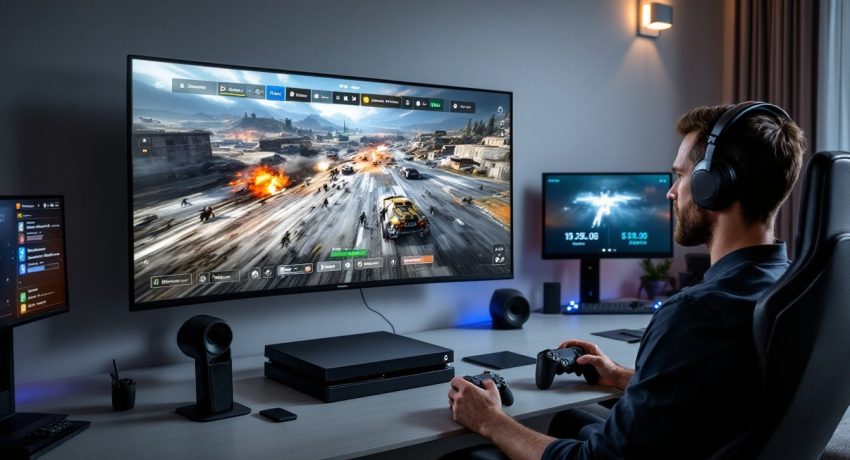

Battlefield on PS4 has been a powerhouse in console gaming for over a decade, offering massive multiplayer maps, vehicle combat, and squad-focused gameplay that sets it apart from other shooters. Whether you’re picking up Battlefield 4, Battlefield 1, Battlefield V, or Battlefield 2042 PS4, the core appeal remains the same: large-scale warfare where positioning, teamwork, and loadout strategy matter just as much as raw aim. If you’re new to the franchise or returning after a hiatus, this guide covers everything from choosing the right title to dominating in multiplayer. Let’s break down what makes Battlefield the franchise it is and how to excel on your PS4.
Table of Contents
ToggleKey Takeaways
- Battlefield PS4 offers five distinct titles—ranging from Battlefield 4 to Battlefield 2042—each with unique gameplay mechanics, from classic gunplay to specialist-based combat.
- Adjusting sensitivity settings, disabling motion blur, and using a quality headset are essential first steps to gain a competitive edge in Battlefield multiplayer.
- Master your weapon loadout by understanding your engagement range and coordinating with your squad to ensure balanced team composition and resource management.
- Winning in Battlefield PS4 depends on learning map flow, controlling strategic chokepoints and power positions, and prioritizing objective play over raw killstreak padding.
- Positioning and squad-based teamwork trump aim and reflexes—rotate after kills, avoid predictable patterns, and let patience and map awareness drive your success in large-scale warfare.
Which Battlefield Titles Are Available on PS4
PS4 players have access to a solid lineup of Battlefield titles spanning nearly a decade of franchise evolution. The main native PS4 versions include Battlefield 4 (2013), Battlefield Hardline (2015), Battlefield 1 (2016), Battlefield V (2018), and Battlefield 2042 (2021). Each title brings its own flavor, from the modern-day gunplay of BF4 to the trench warfare atmosphere of BF1 and the WWII setting of BFV.
Battlefield 2042 on PS4 runs a 64-player version compared to the 128-player versions on PS5 and newer platforms, but it’s still the latest entry if you want cutting-edge Specialist gameplay and seasonal battle pass content. According to comprehensive Battlefield rankings, each title has carved out its own legacy with different strengths in map design, weapon balance, and community engagement.
If you’re deciding which to jump into, BF4 remains the most mechanically sound, BF1 nails atmosphere, BFV excels at fortifications and squad play, and Battlefield 2042 PS4 offers the most modern specialist-based gameplay. Your choice really depends on whether you prefer classic all-arounder gunplay or the newer gadget-focused approach.
Getting Started: Essential Controls and Settings
Out of the box, default PS4 controls work fine, but tweaking your settings immediately will give you a competitive edge. The standard layout has you moving with the left stick, aiming with the right stick, firing with R2, and using L2 to aim down sights. Jump is cross, crouch or prone is circle, reload is square, and melee varies by title but usually maps to R3.
The settings you should adjust first are sensitivity and aim assist. Most top players run hipfire sensitivity between 40-60 and ADS sensitivity slightly lower for precision. Motion blur should be off or low, it muddies your vision during gunfights. Field of view, if available, should sit around 80-90 to give you better peripheral awareness. Audio settings are critical too: use a good headset and bump dialogue volume down while keeping footsteps and vehicle sounds clear.
If you’re coming from other shooters, expect Battlefield’s controls to feel looser and more momentum-based, especially in older titles like BF4. Spend an hour in Team Deathmatch adjusting until tracking lateral targets feels smooth. The goal is muscle memory, you want your fingers working on instinct, not thought. Check PlayStation’s official controller guide for platform-specific optimization tips.
Master Your Weapons and Loadout Strategy
Weapon categories are consistent across all PS4 Battlefield titles: assault rifles for all-around performance, carbines and SMGs for close quarters, LMGs for suppressive fire, DMRs for mid-range precision, sniper rifles for long range, and shotguns for point-blank. Each class or specialist excels with specific weapon families, so knowing your role is half the battle.
In Battlefield 4 and Hardline, you’re locked into traditional classes: Assault handles medkits and revives, Engineer brings anti-vehicle firepower, Support suppresses and resupplies ammo, and Recon spots enemies and controls angles. Battlefield 1 and V stick to this four-class structure but with era-specific weapons. Battlefield 1 especially rewards tighter positioning since most fights happen at closer ranges with weaker optics.
Battlefield 2042 PS4 ditches the strict class system for Specialists, each operator has unique gadgets like grappling hooks or healing pistols, but any specialist can equip most primary weapons. This flexibility means your loadout is less about what slot you fill and more about combining gadgets with weapon roles intelligently.
Here’s the loadout fundamentals: always carry one primary for your engagement range, a sidearm backup, one anti-vehicle or utility gadget, and grenades. On tight maps like Rush, go SMG-heavy. On large Conquest maps, mix long-range DMRs with close-range tools on your squad. Coordinate with your team, if no one’s carrying ammo, you’ll all run dry. The meta shifts with patches, but positioning and awareness trump gun stats every time.
Dominate Multiplayer Modes and Map Layouts
Conquest is Battlefield’s signature mode: two teams fight for control of multiple flags across large maps, draining enemy tickets as you maintain objective hold. The strategy isn’t to pad your killstreak, it’s to control linked clusters of flags and deny enemy spawns. Stick with your squad, spawn on teammates near objectives, and use vehicles to cover exposed flanks.
Rush and Breakthrough are linear, sector-by-sector modes where attackers destroy objectives and defenders hold chokepoints. These modes demand tighter coordination: defenders should fortify high-traffic corridors with mines (BFV) and explosives, while attackers use smoke to push objectives safely. Squad Deathmatch and Team Deathmatch shrink the scope to smaller maps and pure gunfights, useful for warming up but less Battlefield-like than objective play.
Battlefield 2042 introduces Hazard Zone, a squad extraction mode with limited respawns. You collect data drives and fight to extract alive. It rewards tactical positioning and intel from gadgets over raw aim.
Understanding map flow accelerates your climb. Every Battlefield map has chokepoints (narrow bridges, corridors), power positions (multi-story buildings, hills with overwatch), flanking routes (side streets and alleys), and vehicle lanes (wide-open roads). Drop into Conquest first and run the same map 3-4 times to identify where fights cluster, where vehicles spawn, and which flanks teammates ignore. Watch the minimap constantly, firing reveals enemy positions unless they’re suppressed or using silencers. Gaming news outlets regularly break down map strategies for seasonal updates on Battlefield 2042 PS4.
Top Tips for Improving Your Gameplay
Use a wired network connection if possible, lag in Battlefield is brutal, and even a stable 40ms beat 60ms with packet loss. Warm up in Team Deathmatch or against bots before jumping into 64-player Conquest: your aim needs 10-15 minutes to dial in.
In gunplay, short bursts rule mid-to-long range: full auto works in close quarters but kicks hard. Learn your primary weapon’s recoil pattern and use attachments that match your playstyle, vertical grips reduce climb, while angled grips improve ADS speed. Aim for upper chest: recoil climbs, so you’ll naturally track to the head. Don’t challenge enemies in open ground unless you have smoke or height advantage: move from cover to cover and never re-peek the same angle twice.
For positioning, avoid predictable sprints through choke points. If you kill someone from a doorway, don’t camp that door, rotate to a new angle. Play around your squad’s positions: if three teammates are pinned left, push the right flank. As a Medic in BF1/V, prioritize revives behind cover and use smoke to shield fallen teammates. As Support, keep vehicles alive with repairs and ammo drops.
Vehicles are force multipliers on large maps. Tanks work best at range with angle armor toward threats rather than sideways broadsides. Helicopters and jets have steep learning curves: play empty or co-op servers first if available. Most important: don’t spawn alone into a 1v4 situation hoping your reflexes save you. Patience and positioning trump aim every single time in Battlefield.
Conclusion
Battlefield on PS4 offers five distinct but interconnected experiences, each with its own rhythm and tactical depth. Whether you’re grinding Battlefield 4’s classic gunplay, stalking enemies through BF1’s atmospheric maps, fortifying positions in BFV, or experimenting with Specialists in Battlefield 2042 PS4, success comes down to three things: understand your role, learn your map, and trust your squad. Adjust your settings, practice in low-pressure modes, and focus on positioning over killstreaks. The franchise’s legacy isn’t built on run-and-gun heroics, it’s built on teamwork, strategy, and players who think two steps ahead. Master those principles and you’ll dominate regardless of which Battlefield title you choose.