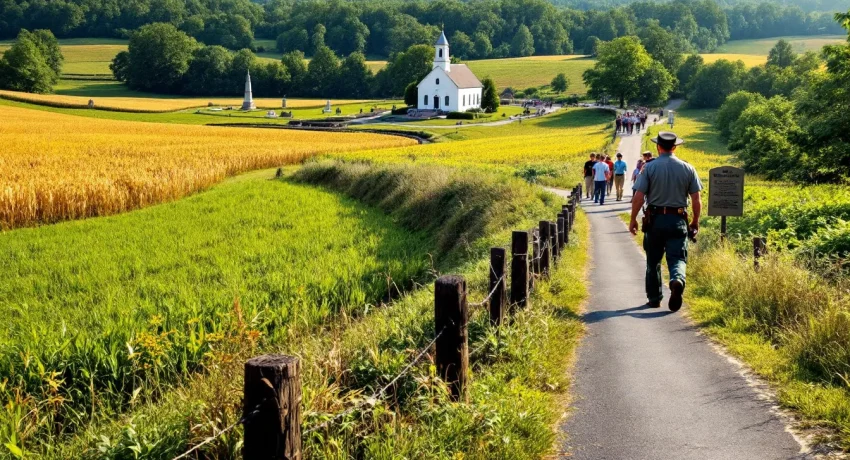

On September 17, 1862, over 23,000 soldiers fell in a single day near Sharpsburg, Maryland, making the Battle of Antietam the bloodiest day in American military history. Today, Antietam National Battlefield preserves that ground, offering visitors a chance to walk the same fields where Union and Confederate forces clashed in desperate combat. Whether someone’s a first-time visitor or a seasoned Civil War buff, understanding the tour options and planning ahead makes all the difference between a rushed drive-through and a genuinely immersive experience that brings the battle’s chaos and significance into focus.
Table of Contents
ToggleKey Takeaways
- Antietam National Battlefield preserves the site of America’s bloodiest day (September 17, 1862, with 23,000+ casualties) and offers multiple tour options from self-guided drives to expert-led private guides to match any visitor preference.
- Self-guided driving tours take 2-3 hours for an 8.5-mile route, while ranger-led programs and licensed battlefield guides provide deeper tactical and historical insights for visitors seeking immersive learning experiences.
- The battlefield’s compact 3,000-acre landscape, authentic 1862 appearance, and well-preserved structures like Dunker Church and Burnside Bridge make Antietam uniquely accessible for physically tracing troop movements compared to larger Civil War sites.
- Visit during spring or fall for ideal weather and landscapes, allocate at least half a day for meaningful engagement, start at the Visitor Center for essential context, and follow the chronological tour route to understand how each battle phase connected.
- Admission is $10 per person ($20 per family as of 2026), with nearby attractions including the Pry House Field Hospital Museum, Harpers Ferry, and South Mountain Battlefield offering extended Civil War itineraries in the region.
Why Visit Antietam National Battlefield?
Historical Significance of the Battle of Antietam
The Battle of Antietam marked a pivotal turning point in the Civil War. Though tactically inconclusive, the Union’s ability to halt Robert E. Lee’s first invasion of the North gave President Lincoln the political momentum to issue the Emancipation Proclamation five days later. That executive order transformed the war’s objective from purely preserving the Union to ending slavery itself.
The scale of casualties in a single day, roughly 3,650 killed and nearly 20,000 wounded or missing, exceeded the combined American losses of the Revolutionary War, War of 1812, and Mexican-American War. The battle unfolded across three distinct phases: morning combat in the Cornfield and around Dunker Church, midday fighting at Bloody Lane, and afternoon action at Burnside Bridge. Each phase produced its own hellish tableaux of violence that eyewitnesses struggled to describe.
What Makes Antietam Different from Other Civil War Sites
Unlike sprawling battlefields like Gettysburg or heavily developed sites like Manassas, Antietam’s compact 3,000-acre landscape retains much of its 1862 appearance. The rolling farmland, stone bridges, and country lanes look remarkably similar to wartime photographs, creating an unusually authentic sense of place.
The battlefield’s preservation is exceptional. Many key structures, including Dunker Church (reconstructed on its original foundation), the Mumma and Roulette farmhouses, and Burnside Bridge, stand exactly where they did during the fight. The National Park Service maintains the fields in historically accurate crops, so visitors in late summer can see corn growing in the Cornfield or hay in the fields around Bloody Lane, just as soldiers did in 1862.
Antietam also tends to be less crowded than Gettysburg, allowing for more contemplative touring. The smaller scale makes it possible to walk between major sites, physically tracing troop movements in a way that’s impractical at larger battlefields.
Types of Antietam Battlefield Tours Available
Self-Guided Driving Tours
The Antietam Battlefield Auto Tour follows an 8.5-mile route marked by numbered stops that correspond to the battle’s chronological progression. The Park Service provides a detailed tour brochure at the Visitor Center, and the official NPS app includes audio descriptions for each stop.
The route takes 2-3 hours at a leisurely pace, with parking areas at each significant site. Visitors can exit their vehicles to explore monuments, read interpretive signs, and walk short trails at key locations. The driving tour works well for families with young children, visitors with mobility limitations, or anyone wanting a comprehensive overview without extensive walking.
One advantage: the self-guided approach allows complete control over pacing. Visitors can skip stops that don’t interest them or spend an hour at Bloody Lane if that’s where their focus lies.
Ranger-Led Programs and Guided Walks
National Park Service rangers offer free programs throughout the year, with expanded schedules during peak season (April through October). These typically include:
- Battlefield walks focusing on specific phases of the battle (The Cornfield, Bloody Lane, Burnside Bridge)
- Talks at key sites providing tactical analysis and soldier accounts
- Evening programs at the Visitor Center covering broader themes like medical care, leadership decisions, or the battle’s political impact
Ranger programs usually last 30-90 minutes and require no advance registration, just show up at the scheduled time and location. Rangers bring deep knowledge and often share primary source accounts that don’t make it into standard tour materials. The interactive format allows visitors to ask questions and dig into specific aspects that interest them.
Check the park’s event calendar before visiting, as program schedules vary by season and staffing levels.
Private Licensed Battlefield Guide Tours
Licensed Battlefield Guides (LBGs) offer the most detailed and customizable tour experience. These independent historians undergo rigorous training and testing by the Park Service, ensuring expert-level knowledge. Private guide tours typically run 2-4 hours and can be tailored to specific interests, whether that’s tactical movements, the Maryland Campaign context, photography, or connecting ancestor service to battlefield locations.
Rates as of 2026 generally range from $75-125 for a two-hour tour, with pricing varying by guide and group size. Guides can accommodate up to six people in one vehicle or follow visitors in their own car. Booking in advance is strongly recommended, especially for weekend visits during spring and fall.
The value proposition: LBGs provide insights and storytelling that exceed what self-guided or even ranger programs can offer. They know which vantage points best illustrate troop movements, can read the terrain to explain tactical decisions, and often share lesser-known accounts from diaries and letters.
Bus and Group Tours
Several regional tour companies include Antietam in multi-day Civil War itineraries, often pairing it with Harpers Ferry, Gettysburg, or other Maryland Campaign sites. These motorcoach tours handle all logistics and typically include a step-on guide who boards the bus specifically for the Antietam portion.
Group tours work well for visitors without their own transportation or those wanting a comprehensive regional experience without planning multiple stops. The trade-off: less flexibility in pacing and stop selection compared to self-guided or private options.
Some companies also offer specialized tours during the September anniversary week, when living history demonstrations and memorial events attract larger crowds.
Planning Your Antietam Battlefield Visit
Best Times to Visit Antietam
Seasonal considerations significantly impact the touring experience. Spring (April-May) brings moderate temperatures and blooming landscapes but can mean muddy trails after rain. Fall (September-October) offers the most dramatic scenery with changing leaves and comfortable weather, though the anniversary weekend (around September 17) draws peak crowds.
Summer can be hot and humid, with temperatures regularly reaching the upper 80s or 90s, similar to what soldiers endured in September 1862. Early morning visits help beat the heat. Winter touring has its own appeal: thinner crowds, stark landscapes that emphasize the terrain, and a somber atmosphere that suits the battlefield’s tone. But, some walking trails may be icy, and the Visitor Center operates on reduced winter hours.
Weekday visits generally mean smaller crowds than weekends, regardless of season. The battlefield opens daily from dawn to dusk, allowing for sunrise or sunset touring that many visitors find particularly moving.
How Much Time to Allocate for Your Tour
Minimum visit time depends on touring approach:
- Quick overview: 2-3 hours for the driving tour with brief stops
- Thorough exploration: 4-5 hours including the Visitor Center film, driving tour, and short walks at major sites
- In-depth study: Full day (6-8 hours) to walk trails, attend ranger programs, and explore with a licensed guide
- Photography or research: Multiple days for specialized pursuits
First-time visitors should plan at least half a day to absorb the scale and significance of what happened here. Rushing through dilutes the experience, the battlefield rewards patience and contemplation.
Admission Fees and Visitor Center Information
As of 2026, entrance fees are $10 per person (ages 16+) or $20 per family, valid for three consecutive days. Annual passes and federal recreation passes (America the Beautiful, Senior, Access, Military) are accepted. The Visitor Center opens at 9:00 AM daily, closing at 5:00 PM most of the year and 6:00 PM in summer.
The Visitor Center houses a museum with artifacts, uniforms, and weapons, plus a 26-minute orientation film that provides essential context before touring. A well-stocked bookstore offers everything from academic histories to children’s books, maps, and battlefield guides. Restrooms, water fountains, and vending machines are available, important since no facilities exist along the tour route itself.
Key Stops Along the Antietam Battlefield Tour Route
Dunker Church and the West Woods
The modest whitewashed Dunker Church served as a visual landmark throughout the battle, particularly during the morning phase when Union and Confederate forces surged back and forth across the surrounding fields. The original structure was dismantled in 1921 but reconstructed in 1962 on its original foundation using period photographs.
The West Woods immediately behind the church became a killing ground when Union General John Sedgwick’s division advanced without proper reconnaissance and walked into a Confederate ambush. In roughly 20 minutes, Sedgwick lost over 2,200 men, one of the war’s most devastating tactical surprises. Walking the trail through the woods, the dense terrain makes it clear how Confederate forces concealed their position until the last moment.
The Cornfield: Site of Morning Combat
David Miller’s 30-acre cornfield changed hands repeatedly during the battle’s opening phase, with Union and Confederate forces launching attacks and counterattacks through the tall stalks. A Union officer later described the cornfield as being “cut as closely as could have been done with a knife.” The fighting here produced approximately 8,000 casualties in just three hours.
The Park Service plants corn in season, allowing visitors to understand how the crop provided concealment but also deadly confusion as units lost formation and fired into unseen enemies. Monument markers trace the positions of Union and Confederate brigades at different moments in the fighting.
A paved observation area at the cornfield’s northern edge provides an excellent vantage point for understanding the tactical situation and visualizing the repeated assaults.
Bloody Lane (Sunken Road)
Bloody Lane, a farm road worn down by years of wagon traffic, became the focal point of midday combat when Confederate forces under D.H. Hill used it as a natural trench line. For nearly four hours, Union troops launched frontal assaults against this position, resulting in nightmarish carnage.
The breakthrough came when a Union regiment achieved an enfilade position, allowing them to fire down the length of the road rather than directly into it. The resulting slaughter forced Confederate withdrawal and left the sunken road choked with bodies, hence the name that stuck.
Today, visitors can walk along the road and examine the slight depression that provided Confederate defenders their advantage. The observation tower on the Union side offers the perspective attackers faced: a seemingly innocent farm lane that erupted in musket fire. Nearby monuments mark where specific regiments fought, many visitors are drawn to historical battle tactics employed during desperate fighting like this.
Burnside Bridge and the Ninth Corps Assault
The picturesque stone Burnside Bridge across Antietam Creek became the unlikely site of a three-hour tactical nightmare for Union General Ambrose Burnside. Tasked with crossing the creek to attack Lee’s right flank, Burnside fixated on capturing the bridge, even though the creek being fordable at multiple points upstream and downstream.
Confederate sharpshooters on the bluffs above the bridge held off repeated Union assaults until late afternoon, when the 51st New York and 51st Pennsylvania finally stormed across. By the time Burnside’s troops reached Sharpsburg and threatened Lee’s line, Confederate reinforcements under A.P. Hill arrived from Harpers Ferry to drive them back.
The bridge area includes walking trails on both sides of the creek, allowing visitors to see the defensive position that made the crossing so difficult and to walk the route of the eventual Union assault.
Antietam National Cemetery
Located adjacent to the battlefield, Antietam National Cemetery holds the remains of 4,776 Union soldiers, including 1,836 unknown. Established in 1865, the cemetery features a distinctive spoke-and-wheel layout with state sections radiating from a central flagpole.
The cemetery doesn’t contain Confederate dead, those were reinterred in cemeteries throughout the South after the war. The peaceful, well-maintained grounds provide a contemplative counterpoint to the battlefield’s violence. The Private Soldiers Monument at the center, dedicated in 1880, honors the common soldiers who fought and died here.
Many visitors find the cemetery particularly moving as a reminder of the battle’s human cost beyond tactical analysis and troop movements.
What to Bring and Expect on Your Tour
Essential Items for Battlefield Touring
Proper preparation enhances both comfort and educational value:
- Water and snacks: No food or water available along the tour route
- Comfortable walking shoes: Even the driving tour involves short walks on uneven ground
- Weather-appropriate clothing: Layers work best, as temperatures vary throughout the day
- Sun protection: Hat, sunglasses, and sunscreen for summer visits
- Binoculars: Useful for examining distant monuments and terrain features
- Camera: The battlefield offers numerous photographic opportunities
- Tour brochure and map: Available free at the Visitor Center
- Notebook: For jotting down thoughts or questions
Optional but valuable items include a detailed battle history book, period photographs for comparison, and a smartphone loaded with the NPS app for audio descriptions.
Accessibility and Walking Conditions
The Visitor Center and museum are fully wheelchair accessible, as are most parking areas along the tour route. Paved walkways exist at several major stops, including the observation area at the Cornfield and portions of Bloody Lane.
But, many trails involve uneven terrain, grass, and gravel surfaces that may challenge wheelchairs or walkers. The West Woods trail includes roots and slight grades. Burnside Bridge has steep approaches on both sides, though viewing areas exist that don’t require descending to creek level.
Visitors with mobility concerns should focus on the accessible viewing areas and consider a licensed guide who can position their vehicle for optimal viewing at each stop. The driving tour itself presents no accessibility barriers, and much of the battlefield’s story can be understood from parking areas and paved walkways.
Summer humidity and heat can be taxing, particularly for older visitors or those with health conditions. Morning touring helps avoid peak temperatures.
Tips for Maximizing Your Antietam Battlefield Experience
Start at the Visitor Center
Skipping the Visitor Center to head straight to the battlefield is tempting but counterproductive. The 26-minute orientation film provides crucial context about the Maryland Campaign, the battle’s three phases, and its political aftermath. Without this framework, individual stops along the tour become disconnected vignettes rather than chapters in a coherent story.
The museum exhibits show authentic weapons, uniforms, and personal items that help visitors visualize what soldiers carried and wore. The terrain model demonstrates how the landscape influenced tactical decisions in ways that aren’t immediately obvious from ground level.
Spending 45-60 minutes at the Visitor Center before touring pays dividends in comprehension and engagement throughout the rest of the visit.
Follow the Chronological Battle Route
The numbered auto tour follows the battle’s actual progression from morning through afternoon. While it’s physically possible to tour in any order, doing so scrambles the narrative and makes it harder to understand how each phase influenced the next.
Starting at Stop 1 (Dunker Church area) and proceeding in sequence shows how the morning’s savage fighting in the Cornfield and West Woods gave way to the midday bloodbath at Bloody Lane, which in turn was supposed to be supported by Burnside’s afternoon assault from the bridge. The chronological approach reveals Lee’s vulnerability and the missed Union opportunities that prevented Antietam from becoming a decisive victory rather than a tactical draw.
Each stop’s interpretive markers reference earlier and later phases, reinforcing the connected narrative that makes the battle comprehensible.
Attend Living History Programs and Special Events
Antietam hosts living history demonstrations throughout the year, with concentrated programming during Memorial Day weekend, Independence Day, and the battle anniversary in September. These events feature reenactors in period uniforms demonstrating camp life, drill, weapons firing, and tactical formations.
While some history purists dismiss reenacting, well-done demonstrations make abstract concepts tangible. Seeing a regiment form line of battle and execute firing drills illustrates why Civil War combat was so lethal at close range, much like understanding how competitive players approach gaming strategies transforms appreciation of tactics. Watching artillery crews load and fire (blank charges) shows the complex choreography required and the weapon’s noise and smoke.
Special anniversary events often include keynote speakers, candlelight tours, and memorial services that provide perspectives beyond standard touring. Check the park’s event calendar when planning your visit, timing a trip around these programs adds significant value.
Beyond the Battlefield: Nearby Attractions in Sharpsburg
Sharpsburg itself is a small village (population around 700) that’s barely changed since 1862. Many wartime structures still stand, including buildings that served as field hospitals and headquarters. A walking tour of the village takes 30-45 minutes and provides context for the civilian experience during and after the battle.
Pry House Field Hospital Museum, located just outside the main battlefield, served as Union General McClellan’s headquarters and a field hospital. The restored house contains medical exhibits showing Civil War surgical techniques and treatment, sobering material that illustrates why so many wounded men died even after leaving the battlefield. The site opens weekends from May through October.
Harpers Ferry National Historical Park sits just 20 miles south, making it an easy add-on for multi-day trips. The town’s role in John Brown’s raid, its strategic position at the confluence of the Potomac and Shenandoah rivers, and its Civil War significance create natural thematic connections with Antietam.
South Mountain Battlefield, where fighting occurred on September 14 (three days before Antietam), lies about 15 miles east. This smaller, less-developed site offers hiking trails through the mountain gaps where Union forces delayed Lee’s army and discovered the Lost Order that gave McClellan intelligence about Confederate dispositions.
Local restaurants in Sharpsburg and nearby Shepherdstown (West Virginia) provide dining options, though choices are limited, visitors planning lunch should pack food or be prepared for basic fare. The rural setting means no major chain restaurants or extensive tourist infrastructure, which preserves the area’s historical character but requires more planning than visiting larger battlefields.
Outdoor enthusiasts find excellent opportunities along the C&O Canal Towpath, which parallels the Potomac just south of Sharpsburg. The flat, shaded path is ideal for cycling or walking, and several Civil War-related sites dot the route, including historic ferries and canal locks. According to recent outdoor activity guides, combining historical touring with recreational activities appeals to visitors seeking diverse experiences.
Sharpsburg’s small-town atmosphere and lack of commercialization mean visitors encounter the battlefield much as it exists rather than through layers of tourist development. Some find this refreshing: others miss the amenities available at more developed sites. Knowing what to expect helps set appropriate expectations, similar to how game preparation determines whether players enjoy or struggle with a particular title.
Conclusion
Antietam National Battlefield offers something rare: a well-preserved historical landscape where America’s bloodiest day unfolded, maintained with enough authenticity to genuinely transport visitors back to September 1862. Whether someone chooses a quick self-guided drive, an in-depth ranger program, or a full day with a licensed guide, the battlefield rewards engagement with powerful insights into Civil War combat, leadership decisions, and the human cost of political division.
The key to a meaningful visit lies in preparation and pacing. Starting at the Visitor Center, following the chronological tour route, and allocating enough time to walk key sites rather than just driving past transforms a battlefield tour from a checklist exercise into something that lingers in memory. The compact scale and exceptional preservation make Antietam uniquely accessible, visitors can physically trace troop movements and stand in positions where soldiers fought and fell, connecting abstract history to tangible ground in ways few sites allow.